
Content Moderation Tool
Designed a decision-support tool for content moderation, improving clarity, usability, and confidence in high-stakes review workflows.

of users created a repayment plan with at least the recommended monthly payment — and said they'd do the same in a live app.
60%
KPI 1 - Recommended repayment plan adoption
of users set up spending round-ups to passively clear debt faster, understood how it worked — and said they'd use it in a live app.
60%
KPI 2 - Round-ups repayment activation
Thresholds: Success ≥ 70% | Accept 55–69% | Fail < 55%
Threshold: Pass ≥ 60% | Fail < 60%
Project Overview
Duration:
8 weeks
Type:
Perm role at Yoti Ltd.
Company:
Yoti Ltd
Role:
Lead Product Designer
Deliverables:
Lightning research & synthesis, design development and delivery
Collaborators:
Product Manager, Design Head, Engineers
Company Context
- Yoti is a digital identity platform focused on enabling secure identity, age, and consent verification online
- Their mission is to make the internet safer through privacy-first identity and trust solutions
- For this project, Yoti provides core capabilities (IDV, age estimation, facial recognition, eSign) to enable compliant, scalable content moderation workflows
Problem Statement
Someone moderating adult content needs a way to quickly and confidently assess identity, consent, and compliance — without relying on fragmented or manual processes.
Goals
Business
Reduce moderation time and operational costs while improving compliance accuracy and partner trust
Design
Create a clear, unified moderation experience that enables fast, confident decision-making with minimal training
Success Metrics
Subtitle
Business
Reduce interest paid per user and improve repayment completion rates
Design
Make repayment plans easy to understand, build user confidence, and feel satisfying to set up
My Role
- Led the design through lightning research, design development and deliver phases.
- Facilitated workshops and regular stakeholder check-ins to drive alignment across product, engineering, and business teams.
- Partnered closely with the Product Manager to define MVP scope, constraints, and success metrics.
- Translated complex requirements into clear design decisions and communicated them effectively to cross-functional stakeholders.
Process
- Aligned on goals through a kickoff, then ran rapid research and competitor analysis to build context
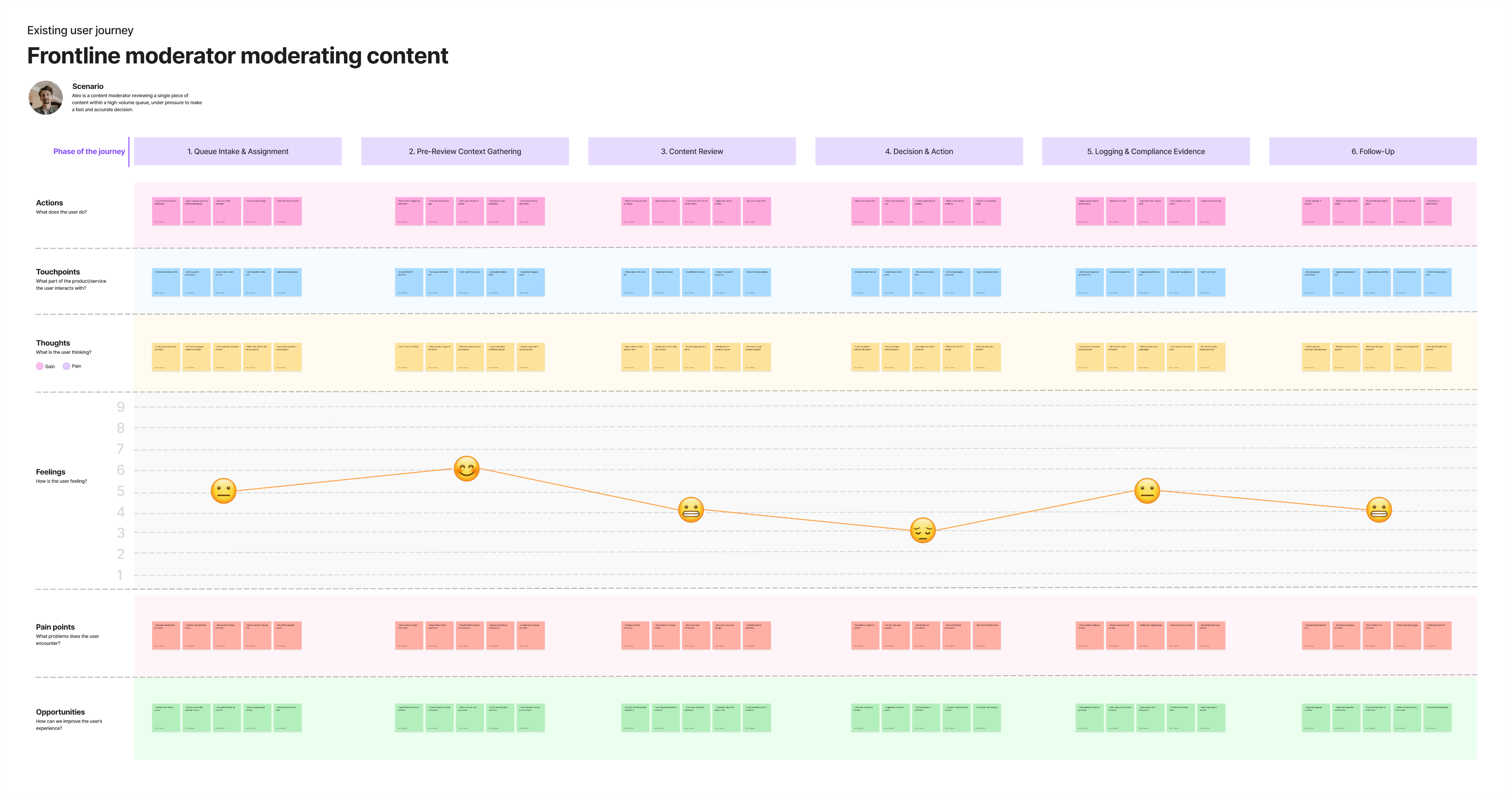
- Mapped the as-is journey and synthesized insights into a clear problem definition
- Defined the future service experience and translated it into user flows and wireframes
- Prototyped and tested with users, iterating on feedback
- Worked closely with Engineering and QA through development and validation
Researching the problem
Key Research Insights
Insight 1
Simplicity beats strategy
Users default to easy repayment patterns to avoid cognitive load.
Evidence
Participants split payments evenly rather than comparing interest rates.
Insight 2
No clear debt end date
Payoff timelines feel too complex to calculate.
Evidence
Most participants had never estimated time to full repayment.
Insight 3
Progress drives motivation
Visible milestones keep users engaged and on track.
Evidence
Participants described motivation from watching balances shrink.
Insight 4
Interest feels abstract
Monthly charges feel too small to act on.
Evidence
Participants noticed interest but rarely adjusted behaviour in response.
Insight 5
Financial safety first
Savings buffers feel safer than accelerating repayment.
Evidence
Participants limited payments to protect a savings cushion.
key Research Deliverables
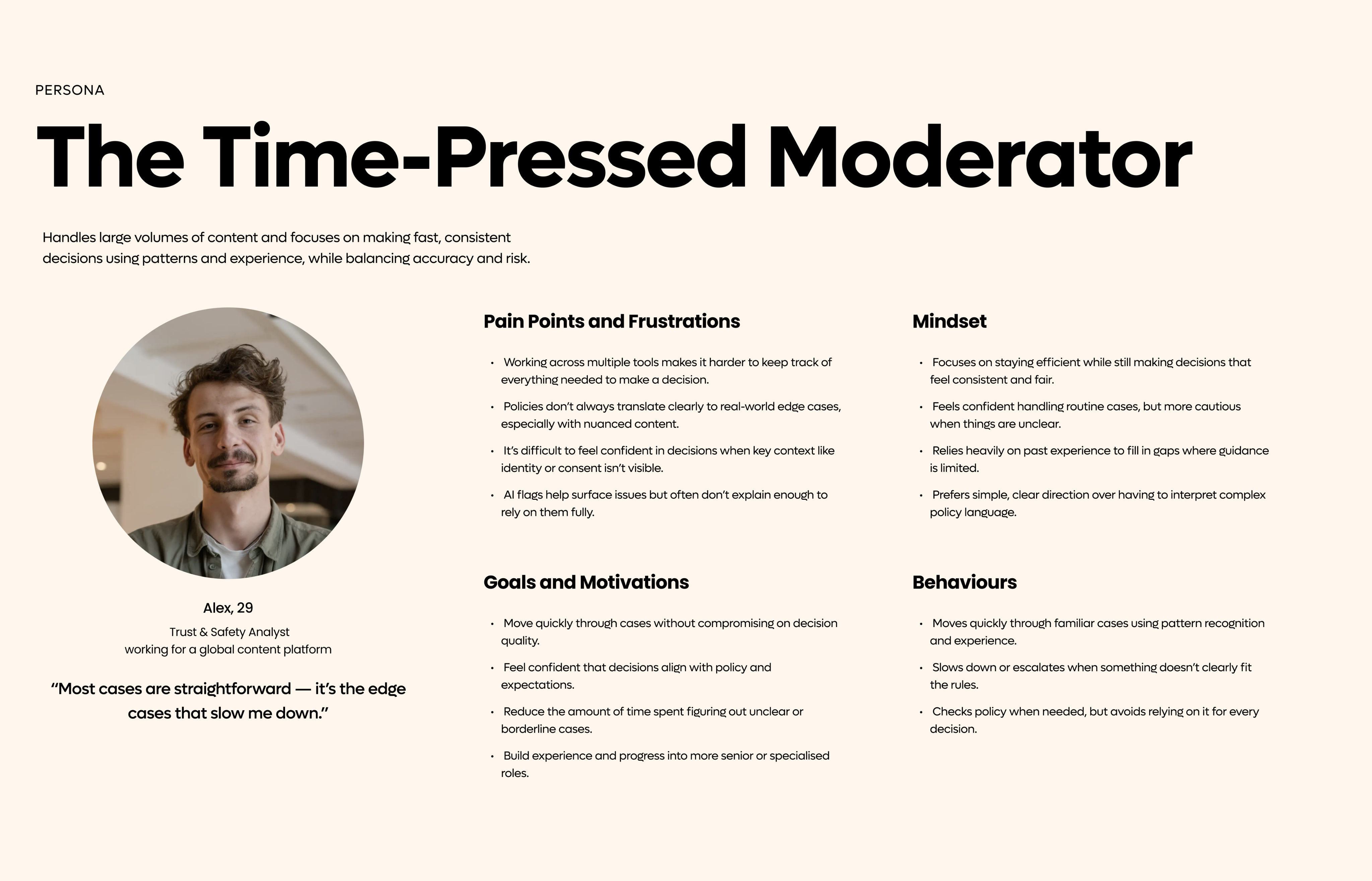
Persona
As-Is User Journey Map
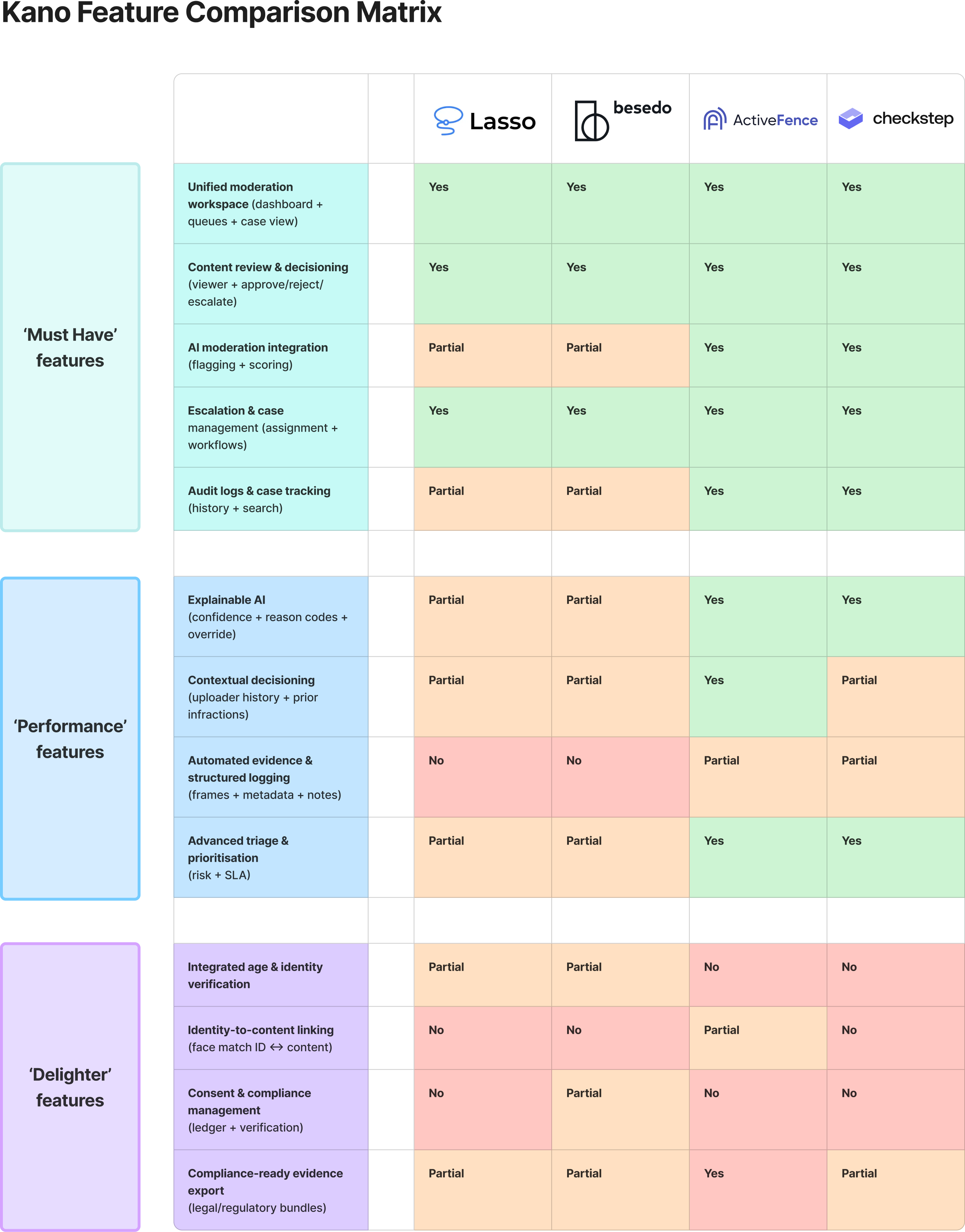
Competitor benchmarking - Kano Feature Comparison Matrix
Kano Feature Comparison Matrix
Developing the design
Hypothesis
We believe that ....
by unifying content moderation, AI signals, and identity verification into a single workbench, for the Time-Pressed Moderator, on adult platforms, we will achieve faster, more accurate, and compliant decisions.
We will know this to be true when we see ...
reduced handling time, fewer escalations, and improved moderator confidence.
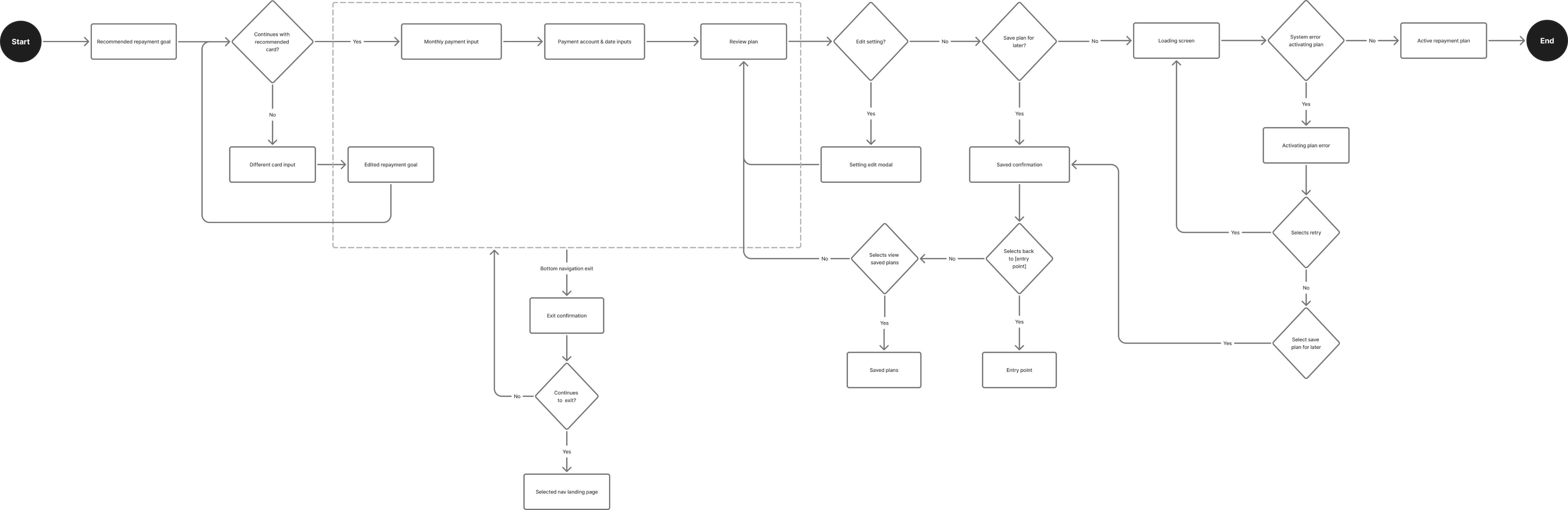
User Flows
Moderating content - High-level flow

Reviewing AI issues - User flow
Verifying & archiving issues
Prototyping &
iterating
Prototype Usability Testing
Subtitle
of users created a repayment plan with at least the recommended monthly payment — and said they'd do the same in a live app.
60%
KPI 1 - Recommended repayment plan adoption
of users set up spending round-ups to passively clear debt faster, understood how it worked — and said they'd use it in a live app.
60%
KPI 2 - Round-ups repayment activation
Thresholds: Success ≥ 70% | Accept 55–69% | Fail < 55%
Threshold: Pass ≥ 60% | Fail < 60%
Prototypes
Reviewing automated issues
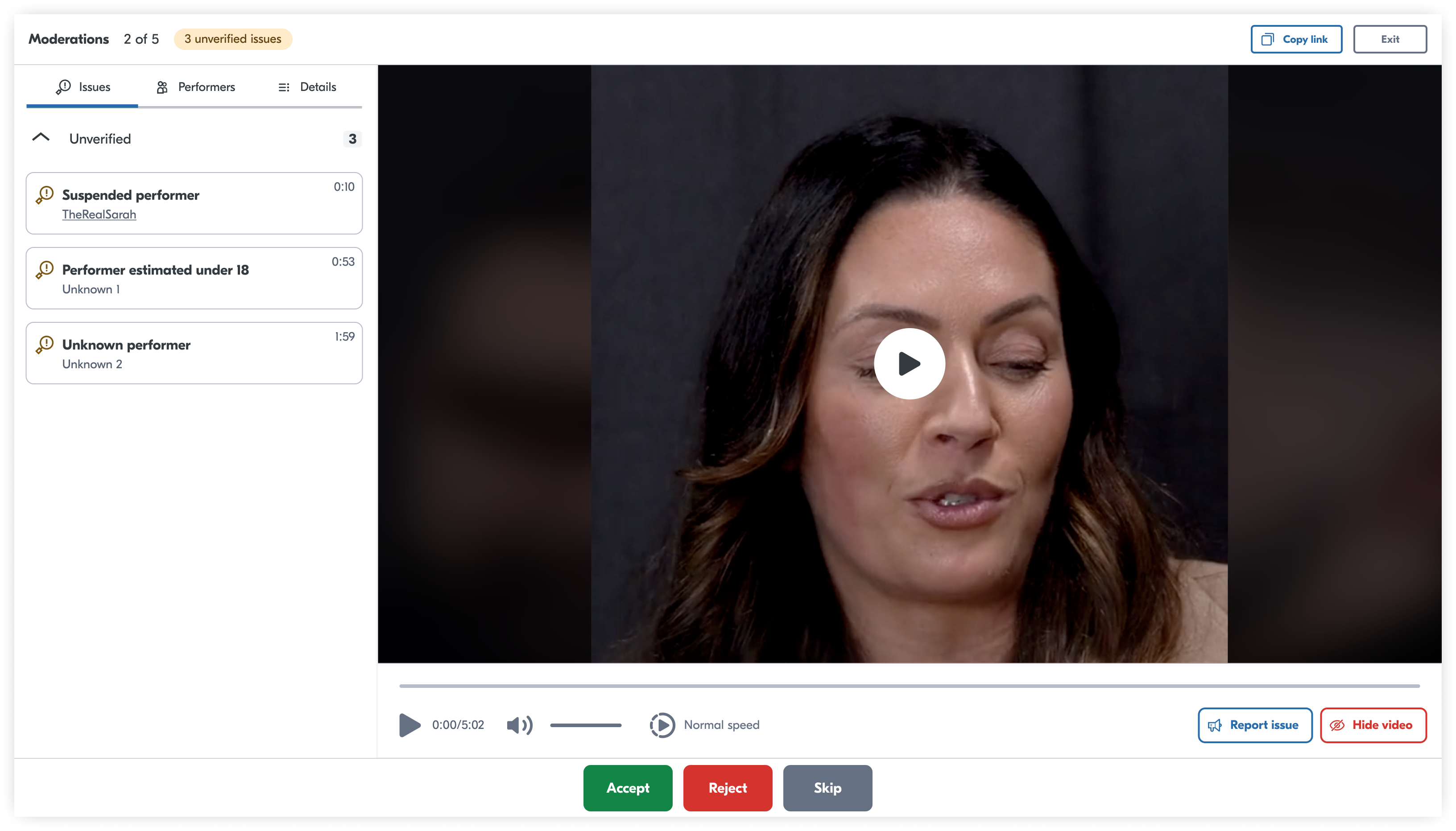
Reporting an issue manually
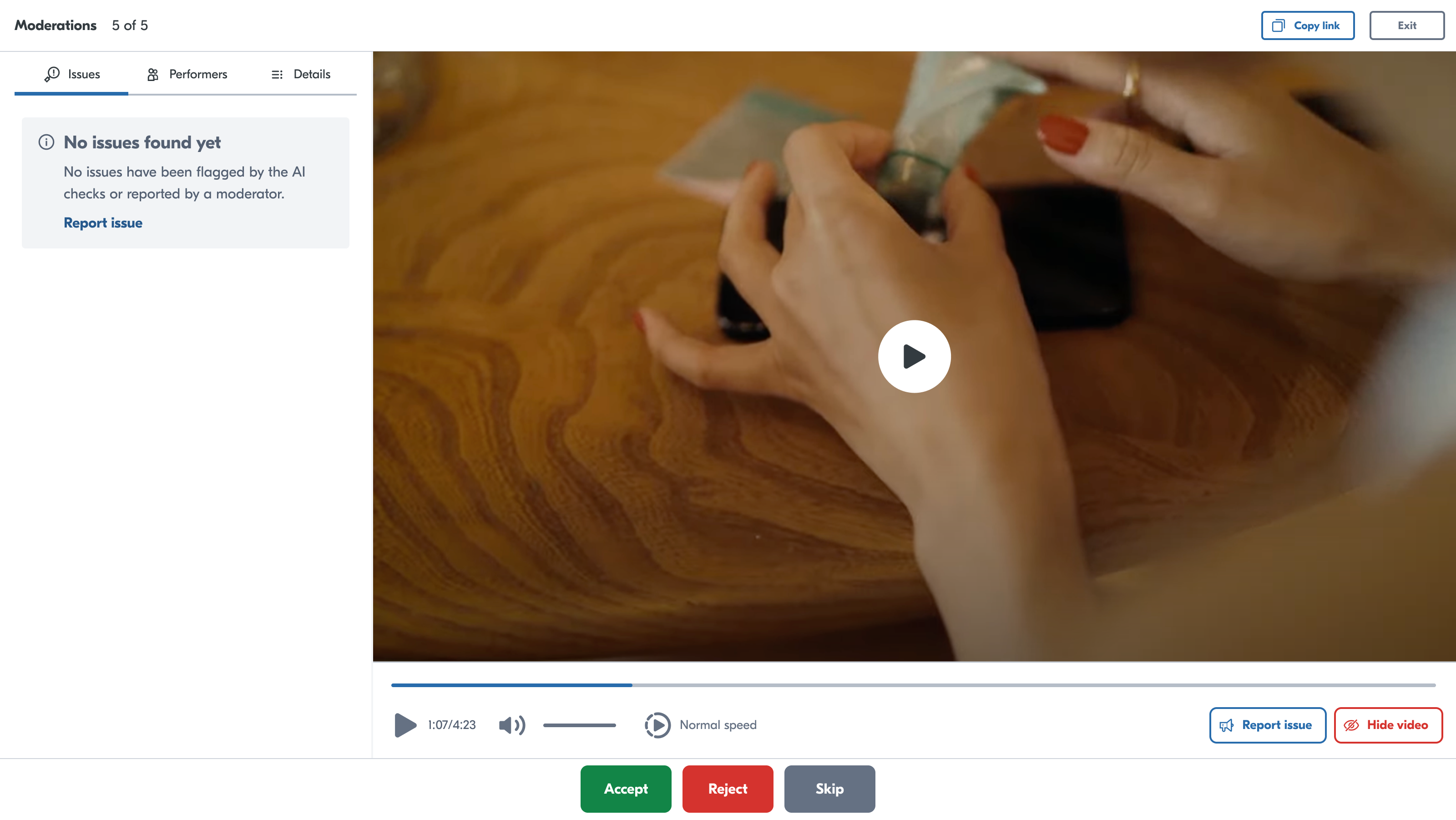
Outcomes & Lessons
Impact
All results were drawn from the final round of usability testing on fully coded prototypes — the most realistic signal of how the design performs in practice.
of users created a repayment plan with at least the recommended monthly payment — and said they'd do the same in a live app.
60%
Recommended repayment plan adoption
KPI 1
- Plan created with at least the recommended monthly payment amount
- Payoff date correctly identified
- Behavioural intent rated ≥ 4/5
Thresholds: Success ≥ 85% | Accept 70–84% | Fail < 70%
Conditions required to include users in the result:
of users set up spending round-ups to passively clear debt faster, understood how it worked — and said they'd use it in a live app.
60%
Round-ups repayment activation
KPI 2
- Round-ups set up for their plan
- How the feature works correctly explained
- Behavioural intent rated ≥ 4/5
Conditions required to include users in the result:
Threshold: Pass ≥ 60% | Fail < 60%
Key Learnings
Through this project, I particularly learnt the value of the following:
Shaping product scope
Partnered with the PM to prioritise MVP features, balancing user needs with delivery constraints.
Rapid research
Used lightning desk research to generate insight quickly when discovery time was limited.
Design–engineering collaboration
Worked closely with engineers to keep designs technically grounded.
End-to-end thinking
Mapped user flows to design across the full moderation flow, not just isolated screens.
Component systems
Designed reusable components, learning to think in systems rather than one-off solutions.
If you like what you see
— Don’t be a stranger! ...
o.hardisty@me.com


Content Moderation Tool
Designed a decision-support tool for content moderation, improving clarity, usability, and confidence in high-stakes review workflows.
of users created a repayment plan with at least the recommended monthly payment — and said they'd do the same in a live app.
60%
KPI 1 - Recommended repayment plan adoption
of users set up spending round-ups to passively clear debt faster, understood how it worked — and said they'd use it in a live app.
60%
KPI 2 - Round-ups repayment activation
Thresholds: Success ≥ 70% | Accept 55–69% | Fail < 55%
Threshold: Pass ≥ 60% | Fail < 60%
Project Overview
Duration:
8 weeks
Type:
Perm role
Company:
Yoti Ltd
Role:
Lead Product Designer
Deliverables:
Lightning research and synthesis, design development and delivery
Collaborators:
Product Manager, Design Head, Engineers
Company Context
- Yoti is a digital identity platform focused on enabling secure identity, age, and consent verification online
- Their mission is to make the internet safer through privacy-first identity and trust solutions
- For this project, Yoti provides core capabilities (IDV, age estimation, facial recognition, eSign) to enable compliant, scalable content moderation workflows
Problem Statement
Someone moderating adult content needs a way to quickly and confidently assess identity, consent, and compliance — without relying on fragmented or manual processes.
Goals
Business
Reduce moderation time and operational costs while improving compliance accuracy and partner trust
Design
Create a clear, unified moderation experience that enables fast, confident decision-making with minimal training
Success Metrics
Subtitle
Business
Reduce interest paid per user and improve repayment completion rates
Design
Make repayment plans easy to understand, build user confidence, and feel satisfying to set up
My Role
- Led the design through lightning research, design development and deliver phases.
- Facilitated workshops and regular stakeholder check-ins to drive alignment across product, engineering, and business teams.
- Partnered closely with the Product Manager to define MVP scope, constraints, and success metrics.
- Translated complex requirements into clear design decisions and communicated them effectively to cross-functional stakeholders.
Process
- Aligned on goals through a kickoff, then ran rapid research and competitor analysis to build context
- Mapped the as-is journey and synthesized insights into a clear problem definition
- Defined the future service experience and translated it into user flows and wireframes
- Prototyped and tested with users, iterating on feedback
- Worked closely with Engineering and QA through development and validation
Researching the problem
Key Research Insights
Insight 1
Simplicity beats strategy
Users default to easy repayment patterns to avoid cognitive load.
Evidence
Participants split payments evenly rather than comparing interest rates.
Insight 2
No clear debt end date
Payoff timelines feel too complex to calculate.
Evidence
Most participants had never estimated time to full repayment.
Insight 3
Progress drives motivation
Visible milestones keep users engaged and on track.
Evidence
Participants described motivation from watching balances shrink.
Insight 4
Interest feels abstract
Monthly charges feel too small to act on.
Evidence
Participants noticed interest but rarely adjusted behaviour in response.
Insight 5
Financial safety first
Savings buffers feel safer than accelerating repayment.
Evidence
Participants limited payments to protect a savings cushion.
key Research Deliverables
Persona
As-Is User Journey Map
Competitor benchmarking - Kano Feature Comparison Matrix
Kano Feature Comparison Matrix
Developing the design
Hypothesis
We believe that ....
by unifying content moderation, AI signals, and identity verification into a single workbench, for the Time-Pressed Moderator, on adult platforms, we will achieve faster, more accurate, and compliant decisions.
We will know this to be true when we see ...
reduced handling time, fewer escalations, and improved moderator confidence.
User Flows
Moderating content - High-level flow
Reviewing AI issues - User flow
Verifying & archiving issues
Prototyping &
iterating
Prototype Usability Testing
Subtitle
of users created a repayment plan with at least the recommended monthly payment — and said they'd do the same in a live app.
60%
KPI 1 - Recommended repayment plan adoption
of users set up spending round-ups to passively clear debt faster, understood how it worked — and said they'd use it in a live app.
60%
KPI 2 - Round-ups repayment activation
Thresholds: Success ≥ 70% | Accept 55–69% | Fail < 55%
Threshold: Pass ≥ 60% | Fail < 60%
Prototypes
Reviewing automated issues
Reporting an issue manually
Screen Flow Diagrams
Reviewing AI issues
Verifying & archiving issues

Click to zoom in and out
Decisioning content
Reject flow
Click to zoom in and out
Outcomes & Lessons
Impact
All results were drawn from the final round of usability testing on fully coded prototypes — the most realistic signal of how the design performs in practice.
of users created a repayment plan with at least the recommended monthly payment — and said they'd do the same in a live app.
60%
Recommended repayment plan adoption
KPI 1
- Plan created with at least the recommended monthly payment amount
- Payoff date correctly identified
- Behavioural intent rated ≥ 4/5
Thresholds: Success ≥ 85% | Accept 70–84% | Fail < 70%
Conditions required to include users in the result:
of users set up spending round-ups to passively clear debt faster, understood how it worked — and said they'd use it in a live app.
60%
Round-ups repayment activation
KPI 2
- Round-ups set up for their plan
- How the feature works correctly explained
- Behavioural intent rated ≥ 4/5
Conditions required to include users in the result:
Threshold: Pass ≥ 60% | Fail < 60%
Key Learnings
Through this project, I particularly learnt the value of the following:
Shaping product scope
Partnered with the PM to prioritise MVP features, balancing user needs with delivery constraints.
Rapid research
Used lightning desk research to generate insight quickly when discovery time was limited.
Design–engineering collaboration
Worked closely with engineers to keep designs technically grounded.
End-to-end thinking
Mapped user flows to design across the full moderation flow, not just isolated screens.
Component systems
Designed reusable components, learning to think in systems rather than one-off solutions.
If you like what you see — Don’t be a stranger! ...
o.hardisty@me.com

Content Moderation Tool
Designed a decision-support tool for content moderation, improving clarity, usability, and confidence in high-stakes review workflows.
of users created a repayment plan with at least the recommended monthly payment — and said they'd do the same in a live app.
60%
KPI 1 - Recommended repayment plan adoption
of users set up spending round-ups to passively clear debt faster, understood how it worked — and said they'd use it in a live app.
60%
KPI 2 - Round-ups repayment activation
Thresholds: Success ≥ 70% | Accept 55–69% | Fail < 55%
Threshold: Pass ≥ 60% | Fail < 60%
Project Overview
Duration:
8 weeks
Type:
Perm role
Company:
Yoti Ltd
Role:
Lead Product Designer
Deliverables:
Lightning research and synthesis, design development and delivery
Collaborators:
Product Manager, Design Head, Engineers
Company Context
- Yoti is a digital identity platform focused on enabling secure identity, age, and consent verification online
- Their mission is to make the internet safer through privacy-first identity and trust solutions
- For this project, Yoti provides core capabilities (IDV, age estimation, facial recognition, eSign) to enable compliant, scalable content moderation workflows
Problem Statement
Someone moderating adult content needs a way to quickly and confidently assess identity, consent, and compliance — without relying on fragmented or manual processes.
Goals
Business
Reduce moderation time and operational costs while improving compliance accuracy and partner trust
Design
Create a clear, unified moderation experience that enables fast, confident decision-making with minimal training
Success Metrics
Subtitle
Two KPIs were defined — one per prototype. Each KPI has three conditions, that had to be met simultaneously to count as a conversion.
KPI 1 — Recommended repayment plan adoptionPercentage of users who created a repayment plan that met the following conditions:
- Plan created with at least the recommended monthly payment amount
- Payoff date correctly identified
- Behavioural intent rated ≥ 4/5
Thresholds: Success ≥ 70% | Accept 55–69% | Fail < 55%
KPI 2 — Round-ups repayment activationPercentage of users who activated round-ups. A pass required:
- Round-ups set up for their plan
- How the feature works correctly explained
- Behavioural intent rated ≥ 4/5
Threshold: Pass ≥ 60% | Fail < 60%
My Role
- Led the design through lightning research, design development and deliver phases.
- Facilitated workshops and regular stakeholder check-ins to drive alignment across product, engineering, and business teams.
- Partnered closely with the Product Manager to define MVP scope, constraints, and success metrics.
- Translated complex requirements into clear design decisions and communicated them effectively to cross-functional stakeholders.
Process
- Aligned on goals through a kickoff, then ran rapid research and competitor analysis to build context
- Mapped the as-is journey and synthesized insights into a clear problem definition
- Defined the future service experience and translated it into user flows and wireframes
- Prototyped and tested with users, iterating on feedback
- Worked closely with Engineering and QA through development and validation
Researching the problem
Key Research Insights
Insight 1
Fragmentation slows everything down
Moderators rely on multiple disconnected tools across brands and workflows.
Evidence
Moderators switch between dashboards, AI tools, ticketing systems, and databases to complete a single review.
Insight 2
Automation exists but isn’t trusted
Payoff timelines feel too complex to calculate.
Evidence
False positives and unclear confidence scores lead to repeated manual verification.
Insight 3
Escalation is inefficient and high-risk
Escalating content requires manual effort and incomplete context sharing.
Evidence
Moderators must re-enter information and attach evidence across separate systems, slowing response times.
Insight 4
Documentation is manual and inconsistent
Capturing evidence and rationale is repetitive and lacks standardisation.
Evidence
Moderators manually take screenshots and write notes, making audits difficult and error-prone.
Insight 5
Feedback loops are broken
Moderators rarely see the outcomes of escalated cases or their impact.
Evidence
Limited visibility into legal decisions or appeals leads to low engagement and unclear performance tracking.
key Research Deliverables
Persona
As-Is User Journey Map
Competitor benchmarking
Kano Feature Comparison Matrix
Developing the design
Hypothesis
We believe that ....
by unifying content moderation, AI signals, and identity verification into a single workbench, for the Time-Pressed Moderator, on adult platforms, we will achieve faster, more accurate, and compliant decisions.
We will know this to be true when we see ...
reduced handling time, fewer escalations, and improved moderator confidence.
User Flows
Moderating content - High-level flow
Reviewing AI issues - User flow
Verifying & archiving issues
Prototyping &
iterating
Prototype Usability Testing
Subtitle
of users created a repayment plan with at least the recommended monthly payment — and said they'd do the same in a live app.
60%
KPI 1 - Recommended repayment plan adoption
of users set up spending round-ups to passively clear debt faster, understood how it worked — and said they'd use it in a live app.
60%
KPI 2 - Round-ups repayment activation
Thresholds: Success ≥ 70% | Accept 55–69% | Fail < 55%
Threshold: Pass ≥ 60% | Fail < 60%
Prototypes
Reviewing automated issues
Reporting an issue manually
Screen Flow Diagrams
Reviewing AI issues
Verifying & archiving issues
Click to zoom in and out
Decisioning content
Reject flow
Click to zoom in and out
Outcomes & Lessons
Impact
All results were drawn from the final round of usability testing on fully coded prototypes — the most realistic signal of how the design performs in practice.
of users created a repayment plan with at least the recommended monthly payment — and said they'd do the same in a live app.
60%
Recommended repayment plan adoption
KPI 1
- Plan created with at least the recommended monthly payment amount
- Payoff date correctly identified
- Behavioural intent rated ≥ 4/5
Thresholds: Success ≥ 85% | Accept 70–84% | Fail < 70%
Conditions required to include users in the result:
of users set up spending round-ups to passively clear debt faster, understood how it worked — and said they'd use it in a live app.
60%
Round-ups repayment activation
KPI 2
- Round-ups set up for their plan
- How the feature works correctly explained
- Behavioural intent rated ≥ 4/5
Conditions required to include users in the result:
Threshold: Pass ≥ 60% | Fail < 60%
Key Learnings
Through this project, I particularly learnt the value of the following:
Shaping product scope
Partnered with the PM to prioritise MVP features, balancing user needs with delivery constraints.
Rapid research
Used lightning desk research to generate insight quickly when discovery time was limited.
Design–engineering collaboration
Worked closely with engineers to keep designs technically grounded.
End-to-end thinking
Mapped user flows to design across the full moderation flow, not just isolated screens.
Component systems
Designed reusable components, learning to think in systems rather than one-off solutions.
If you like what you see — Don’t be a stranger! ...
o.hardisty@me.com